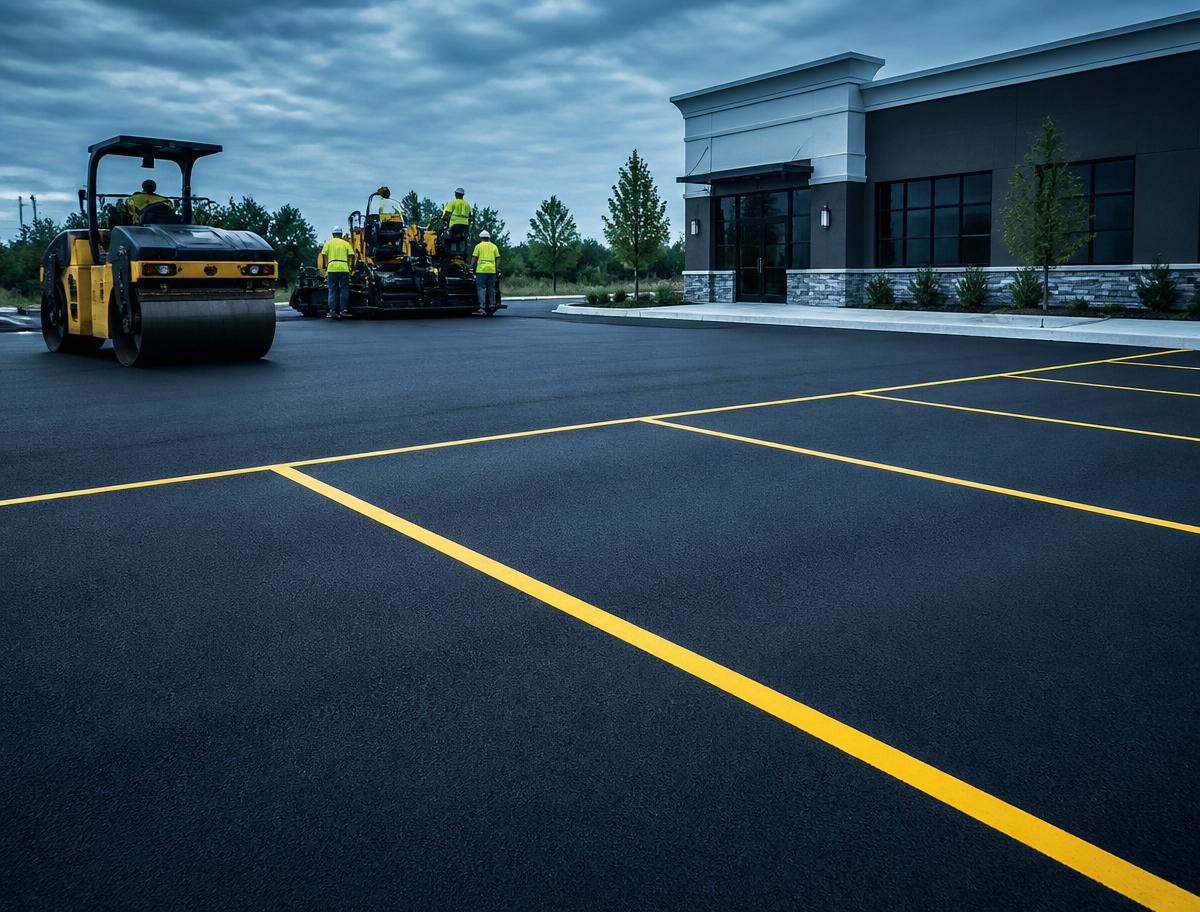
Seal Coating & Asphalt Maintenance
Pavement preservation, repair, and striping that keeps lots and drives looking new.
Midwest freeze-thaw cycles are brutal on asphalt. Water gets into hairline cracks, freezes, and pries the pavement apart — a lot that could last 25 years fails in 12. Our pavement crew seals, fills, patches, and stripes so you spend maintenance dollars instead of replacement dollars.
What's included
Seal Coating
Commercial-grade sealant that blocks UV, water, salt, and fuel while restoring a deep black finish.
Crack Filling & Repair
Routed and hot-rubber sealed cracks that stop water before winter damage spreads.
Asphalt Patching
Saw-cut removal and replacement for potholes, alligatored areas, and failed sub-base.
Line Striping
Fresh stalls, arrows, fire lanes, and ADA-compliant markings in traffic-grade paint.
How the job runs
- Step 1
Assessment
We measure the surface, flag failed areas, and recommend seal vs. patch vs. overlay honestly.
- Step 2
Prep & repair
Sweeping, blowing, oil-spot priming, crack routing and filling, then patching.
- Step 3
Application
Two-coat spray or squeegee application in dry weather above 50°F with a rising forecast.
- Step 4
Cure & stripe
Barricades stay up through cure, then layout and striping before the lot reopens.
Seal Coating & Asphalt Maintenance FAQ
Detailed answers specific to this service. General questions about estimates, insurance, and scheduling are answered on the home page FAQ.
What is seal coating and why does asphalt need it?
Seal coating is a protective emulsion — typically a refined coal-tar or asphalt-based liquid — applied over finished asphalt pavement. Its job is to seal the porous surface against water, UV oxidation, oil, gasoline, and de-icing salts. In northern Illinois and southern Wisconsin, freeze-thaw cycles are severe: water enters tiny surface cracks, expands when it freezes, and widens those cracks into potholes. A quality seal coat acts like a weatherproof skin, reflecting harmful UV rays and restoring the deep black finish. Done professionally, it can double the functional life of asphalt by preventing the top-down oxidation that turns pavement gray, brittle, and prone to raveling.
How often should seal coating be applied to a parking lot or driveway?
For commercial lots and private drives in Lake County, IL and Kenosha County, WI, a typical cycle is every two to three years. The exact interval depends on traffic volume, vehicle weight, the quality of the underlying asphalt, drainage, and sun exposure. A busy retail lot with daily delivery trucks may need attention every two years, while a lightly used residential driveway can often go three to four years. Inspect the surface before it turns pale gray or starts shedding fine aggregate — that is the point where protection is already gone.
What is the difference between crack filling and seal coating?
They solve different problems with different materials. Crack filling is a structural repair: we rout or clean working cracks, then apply a hot-applied rubberized sealant that stays flexible through extreme temperature swings, stopping water from reaching the base. Seal coating is a surface-level protective treatment covering the entire paved area against oxidation, chemicals, and light moisture. Never seal coat over open cracks — the coating will not bridge a gap. The correct sequence is repair cracks and potholes first, then seal the whole surface.
When is the best time to seal coat asphalt in the Midwest?
Seal coating needs sustained ambient and surface temperatures of at least 50°F and rising, no frost in the forecast, and no rain for at least 24 hours after application. In our service area the optimal window is mid-May through late September, though early October can work if the weather holds. We avoid spring applications while frost is still leaving the ground or when nights drop below 50°F, because the coating may not cure properly.
How long does seal coating take to dry and cure?
Dry-to-touch time is typically four to eight hours in warm, dry conditions with good airflow. Full cure and reopening to vehicle traffic usually requires 24 to 48 hours, and heavy trucks or dumpsters should wait 72. Sharp turns and power steering while stationary can scuff fresh seal coat, so lots with high turnover are better off waiting the full 48. We can schedule overnight or weekend applications for businesses that cannot close, and barricades, caution tape, and signage are always included.
What is asphalt patching and when do I need it instead of seal coating?
Patching is a localized repair where pavement has failed structurally: potholes, alligator cracking, sunken or rutted sections, and spots where water has undermined the base. We saw-cut the damaged asphalt, prepare the base, place fresh hot-mix, and compact it to match surrounding grade. Seal coating cannot repair structural failure. If your lot holds standing water after rain, has depressions, or shows visible crumbling, patching comes first — our estimate flags which areas need which fix so you never pay for the wrong one.
Does seal coating hide or fill cracks and potholes?
No. Seal coating is roughly 1/16 to 1/8 inch thick when applied and is not designed to bridge cracks, fill potholes, or level depressions. Applied over unrepaired cracks it masks them briefly, then the cracks reappear as the coating flexes — and in some cases it traps water and makes the problem worse. Clean and fill cracks, patch potholes, and address drainage before sealing. That is why every seal-coating estimate we write includes a pavement condition assessment and any needed prep.
Is seal coating worth it, or should I just repave?
If the pavement is structurally sound with surface cracking, sealing costs roughly a tenth of replacement and can double remaining life. Once the sub-base is failing and you see widespread alligator cracking and potholes, patching or an overlay is the better investment. A well-built asphalt surface lasts 15 to 30 years with maintenance; without it, the same pavement can start failing in 10 to 12 years in our freeze-thaw climate. We will tell you honestly which situation you are in.
What is line striping and when does it need to be refreshed?
Line striping is the painted or thermoplastic marking that defines parking stalls, traffic lanes, directional arrows, crosswalks, fire lanes, loading zones, and ADA-accessible spaces. It should be refreshed every time the lot is seal coated, because the coating covers old paint, and touched up whenever markings fade or accessibility requirements change. We use traffic-grade paint or durable thermoplastic depending on traffic volume, and lay out stalls to meet current Illinois and Wisconsin accessibility standards for lot size.
Can asphalt be seal coated in cold weather or right before winter?
No. Applying seal coat below 50°F or when overnight frost is expected prevents proper curing and can cause the coating to peel, flake, or wash away. Once daytime highs fall consistently below 60°F in our region we stop scheduling seal work and shift to winter prep — plowing, salting, and emergency repairs. If your lot is showing wear in late fall, we can usually crack fill and spot patch to get through winter, then seal the following spring.
Protect your fresh seal coat.
Follow these practical guidelines after seal coating or asphalt repair to get the longest life and cleanest finish from your investment.
Stay off for 24–48 hours
Foot traffic is usually fine after 4–8 hours, but keep cars, bikes, and wheeled equipment off the fresh seal coat for at least one full day — two days for busy commercial lots or in cool, humid weather.
No sharp turns for 72 hours
Turning your wheels while the vehicle is stationary — power steering scuffs — can tear or mar the new surface. Drive straight when possible and avoid parking in the same spot repeatedly during the first week.
Keep heavy loads off at first
Delivery trucks, dumpsters, RVs, and heavy equipment should wait 72 hours before parking on newly sealed asphalt. The seal coat needs time to fully cure and harden under load.
Avoid water and sprinklers
Shut off irrigation systems that overspray the pavement for 48 hours after application. Standing water or repeated wetting can slow curing and cause whitening or streaking.
Watch out for loose chalky residue
A light, dusty surface film is normal during the first few days. It will disappear with normal traffic and rain. Avoid aggressive sweeping or power washing for the first week.
Spot-clean spills quickly
Gasoline, oil, brake fluid, and radiator fluid will soften seal coat if left sitting. Rinse spills with water and a mild detergent as soon as you notice them.
Wait for line striping to dry
If striping was applied the same day, keep traffic off the painted lines for at least an hour. Full traffic can resume once the seal coat has cured — typically the same 24–48 hour window.
Inspect after the first freeze-thaw
Check for new cracks, water pooling, or lifted edges after the first hard freeze. Catching small issues early lets us fix them before winter damage spreads.
How long before you can drive on it?
Set the conditions on your property to estimate safe wait times.
Use the arrow keys for 1°F steps, Page Up / Page Down for bigger jumps.
Estimated safe wait
- Foot traffic4 hr
- Cars & light vehicles1 day
- Trucks & heavy loads2 days
Estimates only. Cooler temps, humidity, shade, and heavy coats all extend curing. When in doubt, give it an extra day — we’ll confirm the exact schedule on site.
Towns we cover
- Waukegan, IL
- Gurnee, IL
- Libertyville, IL
- Antioch, IL
- Lake Forest, IL
- Mundelein, IL
- Grayslake, IL
- Kenosha, WI
- Pleasant Prairie, WI
- Twin Lakes, WI
- Salem Lakes, WI